


Meeting Review
A Review of the CCAN & CCAS Half Day Symposium at the APA & SPA Joint Meeting, May 2015, Aberdeen, Scotland
By Mark Twite, MA, MB, BChir, FRCP
Children’s Hospital Colorado
‘Should auld acquaintance be forgot,
And never brought to min'?
Should auld acquaintance be forgot,
And days o' auld lang syne?’
- Auld Lang Syne, Robert Burns, Scotland 1788
The joint meeting between the Association of Paediatric Anaesthetists of Great Britain and Ireland (APA) and the Society for Pediatric Anesthesia (SPA) took place during May 2015 in Aberdeen, Scotland. The meeting provided an opportunity to compare and contrast practice on both sides of the Atlantic, re-establish ‘auld acquaintances’ and make many new ones! The local organizing committee, led by Dr. Graham Wilson, provided a very warm welcome and the legendary Scottish hospitality was enjoyed by everyone.
Prior to the main meeting there was a half day symposium on congenital cardiac anesthesia which was jointly presented by the Congenital Cardiac Anesthesia Network (CCAN) and the Congenital Cardiac Anesthesia Society (CCAS). Interesting presentation titles had been provided to the speakers. It appears that the biggest challenge was figuring out what was exactly meant by these titles!
The first session, chaired by Dr. Helen Holtby (Toronto, Canada) had three speakers. The first speaker, Dr. Philip Arnold (Liverpool, UK), spoke on ‘Anarchy in the UK – Blalock Taussig (BT) shunts’. Over the past ten years the outcome for cardiac surgery performed in children has continued to improve and all case mortality has almost halved. The exception to this is mortality for neonatal BT shunts which has increased in the UK in the same time period. Dr. Arnold reviewed the UK outcome data, which is not conclusive to the cause of this increased mortality, and he went on to say that is was the impression of many clinicians that there has been an increase in the complexity of patients due to smaller size, less favorable cardiac anatomy and more complex co-morbidities. Dr. Arnold concluded that whilst there are a number of alternative procedures, both in the operating room and the cardiac catheterization lab, the BT shunt shunt remains the only viable palliation for a subset of patients and often the rescue therapy when other approaches fail.
The second speaker, Dr. Mark Twite (Colorado, USA) spoke on ‘Born in the USA, right ventricular outflow tract obstruction (RVOTO)’. The causes of RVOTO include; abnormalities of the mid-RV, the infundibulum, the pulmonary valve, the supravalvar region or the pulmonary arteries. Previous surgery may be responsible for some obstructive lesions as well, for example stenosis of a right ventricle to pulmonary artery conduit. Depending on patient age, anatomy and other factors, a variety of techniques, prosthetic materials and valves are used to reconstruct the RVOT. However, all of these become dysfunctional over time with obstruction, regurgitation or both. The speaker discussed the pathophysiology and treatment options of different forms of RVOTO and the difficulties of choosing the optimal time for re-interventions.
The third talk followed on nicely from this, with Dr. Monica Stokes (Birmingham, UK) speaking on ‘Handsworth Revolution in the Cardiac Catheterization Lab’. She presented the Birmingham experience of stenting the RVOT in the cardiac catheterization lab. Dr. Stokes covered some of the general challenges of working in the cardiac catheterization lab and the specific concerns during stenting of the RVOT.
Afternoon tea and Scottish shortbread was served before the second afternoon session, which was chaired by Dr. Tony Moriarty (Birmingham, UK). Again there were three excellent speakers. The first was Dr. David Vener (Texas, USA) who presented ‘Check Yourself, Data and performance’. Dr. Vener presented the history of the CCAS/STS database and some of the current data. There are approximately 120 surgical programs in the USA of which 112 participate in the surgical database and 47 in the anesthesia portion of the database. The database has served as the foundation for multiple presentations and several publications.
The second speaker was Dr. Helen Holtby (Toronto, Canada) who spoke on ‘Blood and Chocolate, cardiopulmonary bypass and coagulation management’. Dr. Holtby felt a better title was ‘red ink and ketchup’! She pointed out that at the end of a surgical procedure everyone would be much more cheerful if the patient stopped bleeding instantaneously, but that this was seldom the case. The monitoring of both coagulation and anti-coagulation is fraught with variation and error and the ramifications of persistent bleeding are serious: thrombosis, tamponade, cardiac arrest and death.
The final speaker was Dr. Stuart Hall (Texas, USA) who spoke on ‘Atlantic Crossing, training in the UK and the USA’. This entertaining talk examined the similarities and differences between the two training systems for anesthesia and current systems in place for maintenance of certification. The end of the first day concluded with an evening social reception held at the Aberdeen Maritime Museum. This wonderful location provided views over the busy harbor and a chance to meet colleagues from both sides of the pond. Excellent local canapes were served including haggis, local beef stew and fresh fish.
Thursday kicked off the APA/SPA scientific meeting, with parallel sessions. In one session ‘Common problems’ were presented and discussed, including; PONV, diabetes, anaphylaxis and cerebral palsy. In the other session ‘Thoracic anesthesia’ was presented with the following topics; endobronchial strategies, empyema, and analgesia. The next parallel session included ‘The parents say ‘Yes’ but the child says ‘No’ which presented some of the ethical dilemmas of pediatric practice. The other parallel session at this time was ‘Papers that changed my practice’ with Dr. Robert Friesen (Colorado, USA) presenting landmark papers in congenital cardiac anesthesia.
After lunch, there was a fascinating afternoon session on ‘Training for rare events’. The UK perspective was presented by Dr. David Rowney (Edinburgh, Scotland). Dr. Rowney presented the mobile simulation lab he has developed for Scotland and the immersive simulation strategies he uses to create ‘high fidelity’ learning. The USA perspective was presented by Dr. James Fehr (Missouri, USA) who shared his experience of running the center in St. Louis. The remainder of the day was devoted to ‘Management of abnormal BP’ and ‘QI initiatives’.
The social highlight of the meeting was undoubtedly the APA Annual Dinner which was held in a fabulous Art Deco building, on the beach promenade. Dress code was ‘black tie’ or full Scottish regalia! The evening kicked off with drinks and after taking our seats for dinner we enjoyed listening to Dr. Andy Wolf (Bristol, UK) play the bagpipes as he piped in the presidential procession! An excellent dinner was served, including local Scottish smoked salmon, and the wine flowed freely. After dinner an excellent live band guided everyone through Scottish dancing. Not only was it great fun to participate but it was amazing to see everyone on the dance floor having a great time. There can be no better way to bring colleagues together!
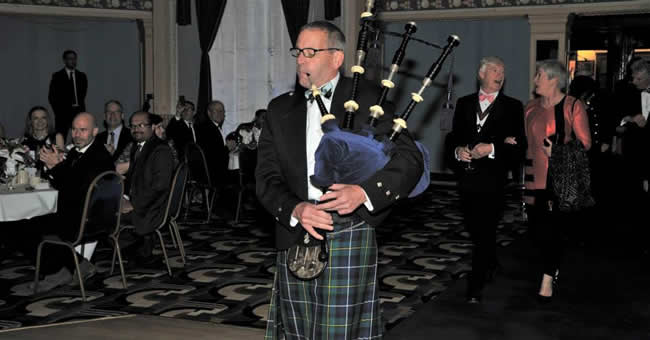
Dr. Andy Wolf leads the ‘Presidents’ Procession’ expertly playing the bagpipes
After a late night of Scottish dancing, the next day a hardy few enjoyed an early morning 5k run along the beach promenade. The weather was perfect with sunshine and blue skies as a few of us ran off the prior evenings excesses! Congratulations to Dr. Mark Thomas (London, UK), who came in an easy first and is probably the fittest and fastest pediatric anesthesiologist on both sides of the Atlantic.
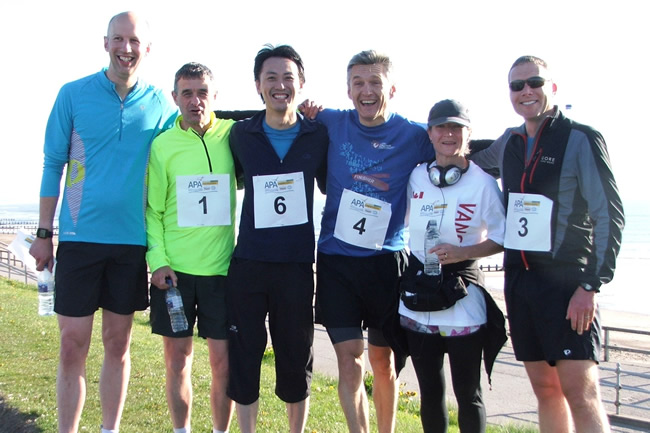
5K runners from around the world! Dr. Mark Thomas (No. 4) proved to be the fastest pediatric anesthesiologist on both sides of the pond
Friday was the final day of the meeting. The morning sessions included ‘Metabolic diseases’ and ‘Charities – contrasting styles’. These were followed by session on trauma and emerging issues. The day concluded with ‘The President’s Session’ where the panel members [Dr. Andy Wolf (President, APA), Dr. Shobha Malviya (President, SPA), Dr. Bob Bingham (Immediate Past President, APA), and Dr. Helen Holtby (President, CCAS)] provided entertaining perspectives on how they would approach different anesthesia scenarios in the ‘real world’. There was active audience participation and many practice differences between institutions and different parts of the world were discussed.
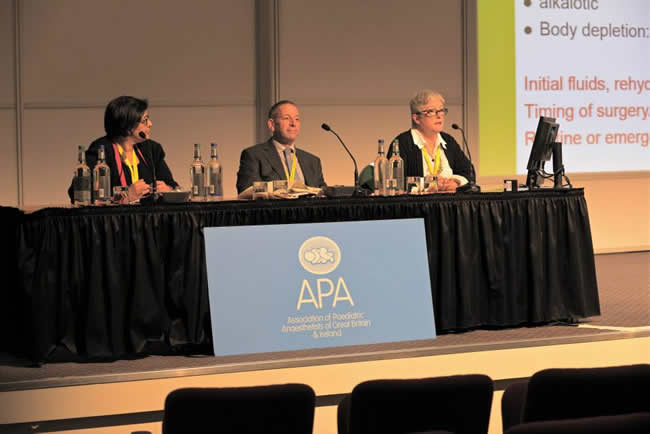
‘Presidents’ Session: Shobha Malviya (President, SPA), Andy Wolf (President, APA) and Helen Holtby (President, CCAS)
The closing session included an awards ceremony where Dr. Robert Friesen was presented with Honorary Membership of the Association of Paediatric Anaesthetists of Great Britain and Ireland. Dr. Friesen is the second American to ever receive this prestigious award, the first one being Dr. Fritz Berry. This closing ceremony was followed by a guest speaker who presented the lessons learned from the Piper Alpha disaster, an off shore oil platform which exploded off the coast of Aberdeen, and resulted in many fatalities.
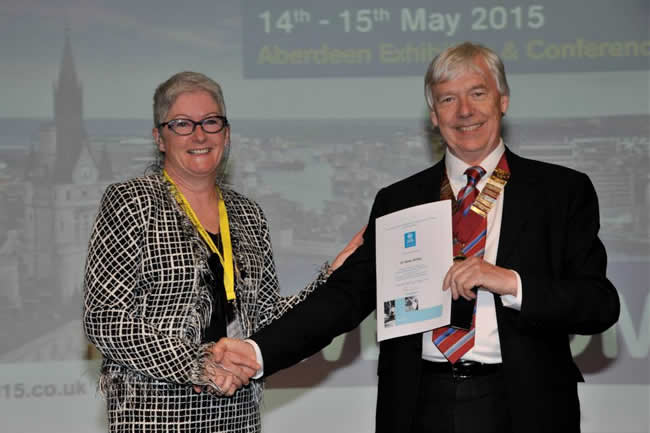
Dr. Helen Holtby receiving the President’s Award
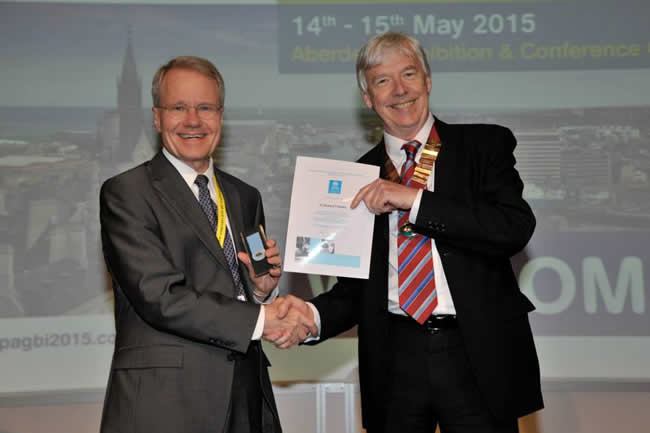
Dr. Robert Friesen is presented with Honorary Membership of the APA from Dr. Bob Bingham, immediate past president of the APA
As 2015 draws to a close, many of us will sing ‘Auld Lang Syne’ on New Year’s Eve, as the clock strikes midnight. However, the words of this famous Scottish song really apply to ‘old friendships’ at any time of the year. It is important the friendships between the AAP and SPA and CCAN and CCAS remain strong and are not ‘forgot’. These societies exist with a common purpose and should work together to tackle common issues. A huge thank you to everyone in the CCAN and AAP who made all of us from the USA feel so very welcome in Scotland.
The words of Robert Burns in the second verse of ‘Auld Lang Syne’ sums up the gratitude felt by everyone who attended:
‘And surely you’ll buy your pint cup!
and surely I’ll buy mine!
And we'll take a cup o’ kindness yet,
for auld lang syne’


