


Featured Articles
Oxygen Toxicity on Bypass: Searching for Best Practice Strategies
Patrick Callahan, MD
Children’s Hospital of Pittsburgh
Pittsburgh, PA
Kelly Machovec, MD, MPH
Duke Children’s Hospital and Health Center
Durham, NC
Read Dr. James DiNardo's Expert Opinion HERE.
Over the past 60 years, the morbidity associated with cardiopulmonary bypass has diminished dramatically. Yet despite significant advancements, questions regarding best practice remain, including the role of oxygen during cardiopulmonary bypass. Studies have investigated the effects of hypoxia on the brain and other vital organs as well as physiologic adaptions in patients who are chronically hypoxic. Investigations now examine the other end of the spectrum, uncovering potentially deleterious effects of too much oxygen.
Judging by current practice at congenital heart centers across the country, concern regarding hyperoxic oxidative stress on cardiopulmonary bypass varies. A November 2015 poll by the CCAS website revealed 67% of respondents practice a normoxic strategy, maintaining PaO2 at 100 - 150 mm Hg (Figure 1). Meanwhile, an informal email poll revealed that few centers have developed protocols to maintain PaO2 within specific limits or distinguish between cyanotic and acyanotic patients in their PaO2 management on bypass.
The bulk of the discussion revolves around the creation and impact of reactive oxygen species (ROS) on the body. We know that oxidative phosphorylation generates ROS such as hydrogen peroxide, hydroxyl radical and superoxide anion as waste. Typically, these byproducts are met by the body’s endogenous antioxidants, and their harmful effects are muted. In the setting of either increased ROS production or diminished antioxidant reserve, cell damage and even cell death may ensue. Lipid peroxidation is one pathway to cell death whereby ROS compromise cell membrane structure and function.1 As levels of ROS are shown to be proportionate to Pa02,2 hyperoxic conditions on bypass may intensify myocardial injury and myocardial dysfunction caused by these processes.
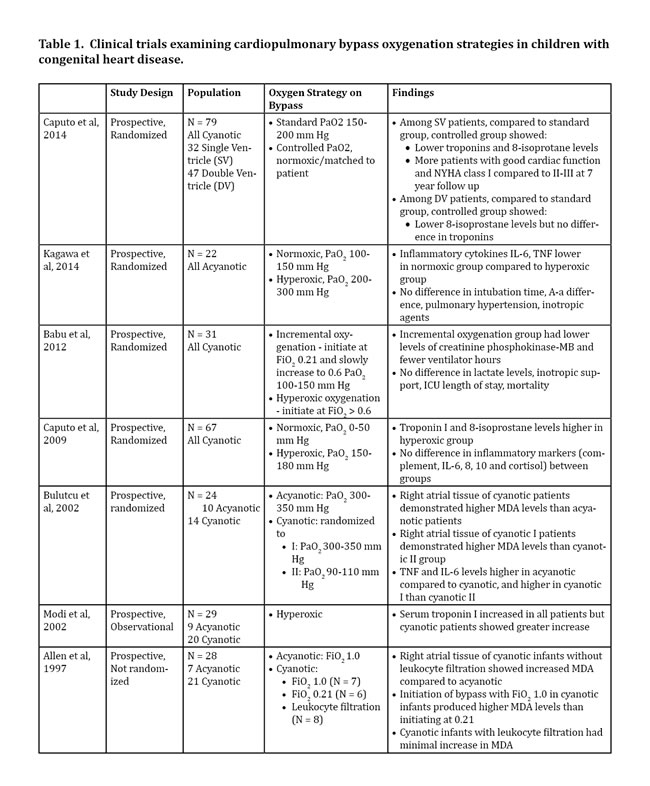
A 2015 systematic review focusing on outcomes in adult patients concluded that the safety of hyperoxia during cardiopulmonary bypass for coronary artery bypass grafting and valve surgery was unproven3. Animal studies examining effects of oxygen injury in cyanotic heart disease in rat4 and piglet5,6 models demonstrate an increase in pro-inflammatory cytokines and worsening ventricular function with a hyperoxic CPB strategy; however, a criticism is that animal models do not reflect chronic hypoxia due to variable physiologic adaptations. Clinical trials examining oxygenation strategies in children with congenital heart disease7-13 (Table 1) examine three classes of biochemical markers: malondialdehyde (MDA), indicating antioxidant reserve capacity with increased levels of MDA indicating antioxidant depletion due to free radical production; 8-isoprostane and troponin I as markers of myocardial cell damage; and inflammatory cytokines including tumor necrosis factor (TNF) and interleukin (IL) as markers of systemic inflammation. While the studies listed provide biochemical evidence of oxidative injury, only three of them describe clinical outcomes, and no large studies investigate morbidity beyond the immediate post-operative period.
In fact, in 1995 neonatologists recognized the damaging effects of free radicals in patients with poor antioxidant reserve. Driven by these findings, protocols were altered and newborns in some centers were resuscitated with the lowest FiO2 possible. Surprisingly, emerging observational data raises potential concerns with these newly implemented strategies as a higher risk of severe neurologic injury or death was seen among preterm infants of ≤27 weeks gestation following a change in practice to initiating resuscitation with either room air or an intermediate oxygen concentration.14
Although oxidative injury is a major concern supporting a normoxic strategy, the risk of microemboli events on bypass supports the hyperoxic strategy. When using high FiO2 on bypass, any emboli formed in the circuit will consist of soluble oxygen, which is readily absorbed and less likely to cause a microvasculature injury.15,16 However, it is important to recognize that our current oxygenators are so efficient that even an FiO2 of 21% will still produce a PaO2 of 140 to 150 mmHg.
Oxygen is a drug and should be treated as such. Clinical data regarding neurologic outcomes and mortality are needed in order determine the best oxygen strategy on bypass.
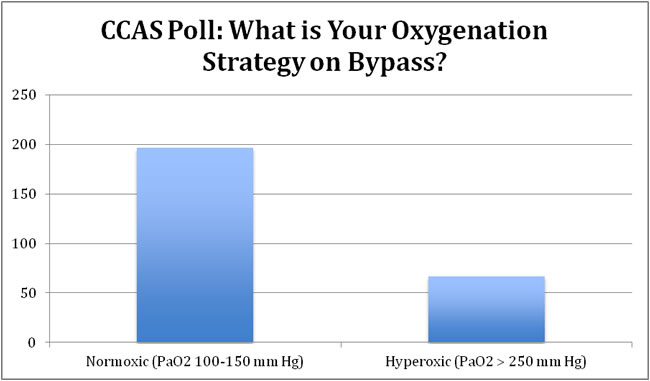
Figure 1. Results of November CCAS poll, 264 respondents.
References:
- Giordano FJ. Oxygen, oxidative stress, hypoxia, and heart failure. The Journal of clinical investigation. Mar 2005;115(3):500-508.
- Morita K. Surgical reoxygenation injury of the myocardium in cyanotic patients: clinical relevance and therapeutic strategies by normoxic management during cardiopulmonary bypass. General thoracic and cardiovascular surgery. Sep 2012;60(9):549-556.
- Spoelstra-de Man AM, Smit B, Oudemans-van Straaten HM, Smulders YM. Cardiovascular effects of hyperoxia during and after cardiac surgery. Anaesthesia. Nov 2015;70(11):1307-1319.
- Samaja M, Motterlini R, Santoro F, Dell’ Antonio G, Corno A. Oxidative injury in reoxygenated and reperfused hearts. Free radical biology & medicine. Feb 1994;16(2):255-262.
- Sadeghi AM, Breda MA, Laks H, et al. Effects of acute hypoxia and reoxygenation in a blood-perfused neonatal heart model. Circulation. Nov 1988;78(5 Pt 2):III158-163.
- Ihnken K, Morita K, Buckberg GD, Winkelmann B, Beyersdorf F, Sherman MP. Reduced oxygen tension during cardiopulmonary bypass limits myocardial damage in acute hypoxic immature piglet hearts. European Journal of Cardio-thoracic Surgery: official journal of the European Association for Cardio-thoracic Surgery. 1996;10(12):1127-1134; discussion 1135.
- Caputo M, Mokhtari A, Miceli A, et al. Controlled reoxygenation during cardiopulmonary bypass decreases markers of organ damage, inflammation, and oxidative stress in single-ventricle patients undergoing pediatric heart surgery. The Journal of Thoracic and Cardiovascular Surgery. Sep 2014;148(3):792-801 e798; discussion 800-791.
- Kagawa H, Morita K, Uno Y, et al. Inflammatory response to hyperoxemic and normoxemic cardiopulmonary bypass in acyanotic pediatric patients. World Journal for Pediatric & Congenital Heart Surgery. Oct 2014;5(4):541-545.
- Babu B, Bhat S, Prabuswamy HP, et al. Controlling oxygenation during initiation of cardiopulmonary bypass: can it improve immediate postoperative outcomes in cyanotic children undergoing cardiac surgery? A prospective randomized study. World Journal for Pediatric & Congenital Heart Surgery. Jul 1 2012;3(3):310-316.
- Bulutcu FS, Bayindir O, Polat B, Yalcin Y, oZbek U, Cakali E. Does normoxemic cardiopulmonary bypass prevent myocardial reoxygenation injury in cyanotic children? Journal of Cardiothoracic and Vascular Anesthesia. Jun 2002;16(3):330-333.
- Modi P, Imura H, Caputo M, et al. Cardiopulmonary bypass-induced myocardial reoxygenation injury in pediatric patients with cyanosis. The Journal of Thoracic and Cardiovascular Surgery. Nov 2002;124(5):1035-1036.
- Allen BS, Rahman S, Ilbawi MN, et al. Detrimental effects of cardiopulmonary bypass in cyanotic infants: preventing the reoxygenation injury. The Annals of Thoracic Surgery. Nov 1997;64(5):1381-1387; discussion 1387-1388.
- Caputo M, Mokhtari A, Rogers CA, et al. The effects of normoxic versus hyperoxic cardiopulmonary bypass on oxidative stress and inflammatory response in cyanotic pediatric patients undergoing open cardiac surgery: a randomized controlled trial. The Journal of Thoracic and Cardiovascular Surgery. Jul 2009;138(1):206-214.
- Rabi Y, Lodha A, Soraisham A, Singhal N, Barrington K, Shah PS. Outcomes of preterm infants following the introduction of room air resuscitation. Resuscitation. Nov 2015;96:252-259.
- Lou S, Ji B, Liu J, Yu K, Long C. Generation, detection and prevention of gaseous microemboli during cardiopulmonary bypass procedure. Int. J. Artif. Organs. 2011; 34 (11): 1039-51.
- KuruszM. Butler BD. Bubbles and bypass: an update. Perfusion. 2004; 19: S49-55.
Expert Opinion
James DiNardo, MD
Boston Children’s Hospital
Boston, MAThe results of this survey and the excellent review of oxygen strategy during CPB provide valuable insights to those providing care to neonates, infants, and children undergoing correction of congenital cardiac defects with CPB. There is no doubt that hyperoxia, is associated with tissue injury under appropriate conditions. It is also clear that hyperoxia reduces gaseous microembolic load and enhances delivery of dissolved oxygen. There is no clear answer to the question of which is the best strategy at present.
As with many things in our specialty, the optimal strategy will likely be age and condition dependent. It remains to be determined, for example how neonatal organs respond to hyperoxia as compared to chronically cyanotic older children. The survey results imply that institutions approach the use of hyperoxia as a binary decision; we do not know if any institutions apply a mixed, selective approach. Selective application of hyperoxia may be the best strategy; use of hyperoxia during CPB periods when the risk of air emboli is highest or when tissue oxygen delivery and tissue oxygen stores are compromised and use of normoxia during periods when the risk of ischemia/reperfusion injury is highest.


