


Advancing Pediatric Cardiac Care Through Collaborative Learning
By Susan C. Nicolson, MD
Medical Director, Operations
The Cardiac Center at The Children's Hospital of Philadelphia
Professor of Anesthesiology and Critical Care Medicine
Perelman School of Medicine at The University of Pennsylvania
Clinicians and researchers advance pediatric cardiac clinical care largely through single center quality improvement efforts and less by conducting randomized multi-center trials. Clinical trials help determine if a new idea or existing practice improves outcomes for a patient population. Patient enrollment, data collection and analysis often takes multiple years at high cost. The results can be outdated due to changes in clinical practice over the course of the trial.
Collaborative learning is a process by which people learn together by capitalizing on one another’s knowledge, experience, skills, ideas, and resources. Collaborative learning involves: 1) topic selection, 2) learning sessions, and 3) rapid implementation of test(s) of change. This approach was first used in the manufacturing industry to attempt to convert low performing units to higher performing units. Its application in medicine is closely aligned with benchmarking, a method of comparing services or outcomes between centers. Dr. William Mahle from Children’s Healthcare of Atlanta (CHOA) recognized that congenital cardiac care might benefit from collaborative learning given the complexity and heterogeneity of the patient population, the geographically dispersed sites of care and the fact that collaboration is an integral part of multi-disciplinary care. A team of physicians from CHOA in conjunction with industrial engineers from Georgia Tech comprehensively evaluated five congenital cardiac programs. These visits identified dramatic variation in clinical practice among centers. Interest in reducing variation provided the impetus for exploring the collaborative learning model within the Pediatric Heart Network (PHN) funded by the National Heart Lung Blood Institute (NHBLI).
The PHN funded a collaborative learning project involving 10 of its core centers. Five centers served as control sites and five centers as active sites. Multi-disciplinary teams from the active sites, composed of a CT surgeon, cardiac intensivist, cardiac anesthesiologist, CICU bedside nurse and respiratory therapist, participated in rotational site visits (each site visited one center and hosted another). Site visits are useful tools in situations where numerous and intricate factors, often closely related, influence outcomes. During these visits data was collected largely from observation of clinical practice increasing the likelihood that unmeasured but important factors receive attention. The teams endeavored to identify outcome variation in perioperative care that would likely be modifiable through a collaborative learning intervention. Criteria used to identify a clinical practice suited for such an initiative include: 1) variation among centers, 2) correlation to clinical outcome, 3) systems based, 4) difficult to influence change through publications alone and 5) potential to reduce resource utilization.
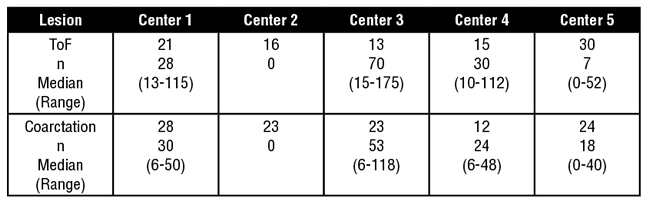
The duration of postoperative mechanical ventilation after common cardiac procedures varied considerably across centers (see table). A decision was reached to focus on practices related to post-operative ventilatory support for the collaborative learning project. The timing of postoperative extubation involves multiple disciplines, encompasses the continuum of care including anesthetic strategy, execution of surgical procedure, ICU care and staffing. Early successful extubation has the potential to reduce ICU and hospital length of stay, lower risk of ventilator acquired pneumonia, decrease need for sedation and allow both earlier re-institution of enteral feeds and application of other non-pharmacologic comfort measures. The target population selected was infants as this population accounts for a large percentage of morbidity and resource utilization in pediatric cardiac centers.
The teams from the five active sites developed a clinical practice guideline (CPG) for early extubation, defined as within 6 hours of completion of the surgery. The CPG would be applied to two groups of infants: repair of Tetralogy of Fallot and coarctation repair via left thoracotomy. The five active sites gathered data for a 12-month period following implementation of the CPG. Components of care that were tracked included duration of post-operative ventilation, re-intubation rate with reason, anesthetic management, post-operative sedation and analgesia strategy, pain scores, time to re-starting enteral feeds and compliance with the CPG. The five control sites, without knowledge of the CPG, gathered data regarding post-operative ventilation for a comparable 12-month period. Both active and controls sites retrospectively collected data on mechanical ventilatory support in the same two groups of infants for the 12 months immediately preceding institution of the CPG. With enrollment complete, data is being analyzed to determine the clinical impact of the CPG.
The collaborative learning process enables evaluation and dissemination of beneficial practices more quickly and with lower cost. This model has potential to be applied to other components of congenital cardiac care if the current application proves beneficial.
Table: Duration of Post-Operative Ventilation (hours) – Active Centers 2010 -2011
Control Sites:
Hospital for Sick Children, Boston Children’s Hospital, Medical University of South Carolina, Riley Children’s Hospital, Cincinnati Children’s Hospital
Active Sites:
Children’s Healthcare of Atlanta, The Children’s Hospital of Philadelphia, Texas Children’s Hospital, C.S. Mott Children’s Hospital, Primary Children’s Hospital


