


Acute Kidney Injury in Congenital Heart Disease
By Rania K. Abbasi, MD
Riley Hospital for Children
Background
Acute kidney injury (AKI) is a well-known complication associated with cardiac surgery. The reported incidence of postoperative AKI in children undergoing surgery for congenital heart disease (CHD) varies from 1-40%1-4. Many of the risk factors for AKI are common in CHD and its surgical palliation. Studies have demonstrated both short and long-term adverse outcomes associated with postoperative AKI in children, including increased length of stays and higher mortality4-7. These consequences emphasize the need for improved identification of risk factors and standardized classification systems that allow for early diagnosis and novel preventive and therapeutic targets for AKI.
Pathophysiology and Risk Factors
The etiology of AKI in congenital cardiac surgery is complex. Various patient, intraoperative, and postoperative factors contribute to renal injury. Previous studies have shown increased risk of postoperative AKI to be associated with younger age, smaller size, cyanosis, cardiopulmonary bypass (CPB) duration, and more complex surgical procedures as defined by higher Risk Adjusted Classification for Congenital Heart Surgery (RACHS-1) scores1-5,8.
CPB is known to induce renal injury through several mechanisms. Ischemia-reperfusion injury, low cardiac output, nonpulsatile blood flow, and vasoconstriction contribute to alterations in renal perfusion. This, in turn, causes cell damage due to inadequate oxygen delivery7. In addition to altered renal perfusion, CPB generates an inflammatory response within the renal tubules, secondary to surgical trauma and exposure to the CPB circuit. Shearing of red blood cells can lead to accumulation of casts within the tubules as well. Both of these mechanisms contribute to further cellular damage7.
Several postoperative factors are associated with an increased risk of AKI. Some of these factors are not exclusive to the congenital cardiac patient, but rather are common to the intensive care setting. Low cardiac output syndrome and hypotension cause renal dysfunction due to inadequate renal perfusion7,8. Sepsis also induces hypotension, but additionally triggers an inflammatory response that causes cellular damage. The use of nephrotoxic medications, such as IV contrast used during cardiac catheterization, may directly damage renal tubules as well7,1.
Diagnosis
In recent years, three major classification systems for AKI have been validated for use in the pediatric population—the pediatric-modified Risk, Injury, Failure, Loss, End-Stage (pRIFLE) criteria; the Acute Kidney Injury Network (AKIN) staging system; and Kidney Disease: Improving Global Outcomes (KDIGO) system. These systems have provided not only a means for earlier detection of AKI, but also more uniformity across studies, allowing for more accurate comparisons9,10,3.
The pRIFLE scoring system assesses the severity of renal dysfunction using estimated creatinine clearance (eCrCl). The stages are distinguished as follows: risk stage is a reduction in eCrCl of less than 25%, injury is a reduction in eCrCl of 25-50%, failure is a reduction in eCrCl of 50-75% or an eCrCl of less than 35 mL/min/1.73 m2. The AKIN system defines stages I through III based on increases in serum creatinine. Stage I is classified as a postoperative rise in serum creatinine by at least 0.3 mg/dL or 150-200%. Stages II and III are classified as a postoperative rise in serum creatinine by 200-300% and greater than 300%, respectively. The KDIGO system utilizes a combination of criteria from the pRIFLE and AKIN systems9,11.
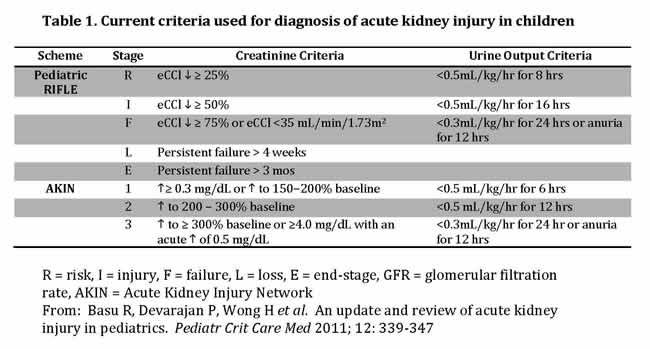
The pRIFLE and AKIN systems have been validated in pediatric cardiac patients. A recent study by Lex et al compared all three classification systems in pediatric cardiac patients. The AKIN system was found to be most specific and the pRIFLE system most sensitive, particularly in the infant population, in detecting AKI. An increase in morbidity and mortality was associated with worse scores in all three systems9,10,3.
While these classification systems have allowed for standardization of AKI definitions, changes in serum creatinine may not be evident until greater than 50% of kidney function is lost, which may not occur until several days postoperatively12,13. Furthermore, various factors, such as extremes of age, can influence serum creatinine12. Thus, recent research efforts have focused on identifying biomarkers that may aid in earlier and more accurate detection of AKI12-15. Such markers as urine IL-18 and urine neutrophil gelatinase-associated lipocalin (NGAL) have been found to be elevated within 12 hours postoperatively in pediatric cardiac patients who later develop AKI defined by serum creatinine. Elevations in these markers also correlate with increased morbidity, such as length of stay and duration of mechanical ventilation13,14. Earlier detection of AKI may allow for improved management strategies in the future.
Outcomes
Postoperative AKI in children undergoing congenital heart surgery has both short and long-term sequelae. Several recent studies have utilized the pRIFLE and AKIN systems and demonstrated increased ICU and hospital length of stays, prolonged duration of mechanical ventilation, and higher mortality4-7. Early studies have linked a higher risk of chronic kidney disease with postoperative AKI; however, these results have not been consistent4.
A 2012 propensity score analysis by Toth et al matched 1,510 pediatric cardiac surgery patients. They noted 32% of patients developed AKI according to the pRIFLE criteria, and these patients had significantly longer durations of mechanical ventilation and ICU stay16. Other studies have demonstrated similar results. Li et al recently prospectively studied 311 congenital cardiac surgery patients using the AKIN staging system. Forty-two percent of patients developed AKI, and this was linked to increased morbidity, including prolonged mechanical ventilation and ICU stays8. A retrospective analysis of 430 infants undergoing congenital cardiac surgery by Blinder et al found 52% of patients developed AKI according to AKIN criteria. AKI in these patients was also linked to prolonged mechanical ventilation and ICU stay. Additionally, AKI stage 3 was associated with ventricular dysfunction on echocardiography upon hospital discharge6.
A study by Morgan et al examined AKI specifically in neonates undergoing congenital cardiac surgery. Sixty-four percent of neonates developed AKI defined by the AKIN staging system. Neonates with AKI had longer durations of mechanical ventilation and ICU stays, as well as higher mortality for those with AKIN stage 2 or greater5.
A 2014 retrospective review by Watkins et al studied 711 pediatric cardiac patients for a mean of four years postoperatively in addition to the immediate postoperative period. Utilizing the pRIFLE system, they demonstrated reduced long-term survival over the follow-up period, associated with younger age, single ventricle physiology, and worse pRIFLE score4. These studies demonstrate the significant impact of postoperative AKI; thus, improvements in early diagnosis and intervention are of paramount importance.
Treatment
Due to the complex nature of AKI, therapeutic interventions are limited. Currently, the primary goal of AKI management in critically ill children is prevention of further renal damage. Avoidance of nephrotoxins is critical. Another focus is maintenance of renal hemodynamics. Low dose dopamine and fenoldopam, a dopamine agonist, have been studied in adults as mechanisms to improve renal blood flow. Results have been varied in the adult population, and they have not been proven as effective AKI therapies in the pediatric population17,18. Optimization of renal preload through appropriate fluid balance can be difficult in the AKI patient. Maintaining adequate urine output with fluid therapy or diuretics has not been shown to improve AKI outcomes. Fluid overload is common in AKI, and in fact is detrimental. Studies in both adults and children have demonstrated an association between fluid overload in AKI and higher mortality rates17. A retrospective study of 116 critically ill children by the Prospective Pediatric Continuous Renal Replacement Therapy (CRRT) group linked greater fluid administration to increased risk of mortality in CRRT patients. The timing and use of CRRT and peritoneal dialysis (PD) is controversial. Initiating CRRT or PD at a positive fluid balance of 10-15% in pediatric AKI patients has been suggested, although improved outcomes have not been proven17.
Summary
AKI in pediatric cardiac patients is a frequent postoperative complication associated with significant morbidity and mortality. Standardization of AKI definitions, as well as research regarding biomarkers, have allowed for earlier detection of AKI. Despite earlier detection, additional research is needed with respect to preventive and therapeutic measures.
References
- Sethi SK, Goyal D, Yadav DK et al. Predictors of acute kidney injury post-cardiopulmonary bypass in children. Clin Exp Nephrol 2011; 15: 529-534.
- Chiravuri SD, Riegger LQ, Christensen R et al. Factors associated with acute kidney injury or failure in children undergoing cardiopulmonary bypass: a case controlled study. Pediatr Anesth 2011; 21: 880-886.
- Aydin SI, Seiden HS, Blaufox AD et al. Acute kidney injury after surgery for congenital heart disease. Ann Thorac Surg 2012; 94: 1589-1595.
- Watkins SC, Williamson K, Davidson M et al. Long-term mortality associated with acute kidney injury in children following congenital cardiac surgery. Pediatr Anesth 2014; 24: 919-926.
- Morgan CJ, Zappitelli M, Robertson CM et al. Risk factors for and outcomes of acute kidney injury in neonates undergoing complex cardiac surgery. J Pediatr 2013; 162: 120-127.
- Blinder JJ, Goldstein SL, Lee VV et al. Congenital heart surgery in infants: effects of acute kidney injury on outcomes. J Thorac Cardiovasc Surg 2011; 143: 368-374.
- Mariscalco G, Lorusso R, Dominici C et al. Acute kidney injury: a relevant complication after cardiac surgery. Ann Thorac Surg 2011; 92: 1539-1547.
- Li S, Krawczeski CD, Zappitelli M et al. Incidence, risk factors, and outcomes of acute kidney injury after pediatric cardiac surgery: a prospective multicenter study. Crit Care Med 2011: 39: 1493-1499.
- Lex DJ, Toth R, Cserep Z et al. A comparison of the systems for the identification of postoperative acute kidney injury in pediatric cardiac patients. Ann Thorac Surg 2014; 97: 202-210.
- Ricci Z, Di Nardo M, Iacoella C et al. Pediatric RIFLE for acute kidney injury diagnosis and prognosis for children undergoing cardiac surgery: a single-center prospective observational study. Pediatr Cardiol 2013; 34: 1404-1408.
- Kidney Disease: Improving Global Outcomes (KDIGO) Acute Kidney Injury Work Group. KDIGO Clinical Practice Guideline for Acute Kidney Injury. Kidney Inter Suppl 2012; 2: 1–138.
- Peco-Antic A, Ivanisevic I, Vulicevic I et al. Biomarkers of acute kidney injury in pediatric cardiac surgery. Clinical Biochemistry 2013; 46: 1244-1251.
- Parikh CR, Devarajan P, Zappitelli M et al. Postoperative biomarkers predict acute kidney injury and poor outcomes after pediatric cardiac surgery. J Am Soc Nephrol 2011; 22: 1737-1747.
- Hazle MA, Gajarski RJ, Aiyagari R et al. Urinary biomarkers and renal near-infrared spectroscopy predict intensive care unit outcomes after cardiac surgery in infants younger than 6 months of age. J Thorac Cardiovasc Surg 2013; 146: 861-867.
- Krawczeski CD, Goldstein SL, Woo JG et al. Temporal relationship and predictive value of urinary acute kidney injury biomarkers after pediatric cardiopulmonary bypass. J Am Coll Cardiol 2011; 58: 2301-2309.
- Toth R, Breuer T, Cserep Z et al. Acute kidney injury is associated with higher morbidity and resource utilization in pediatric patients undergoing hearty surgery. Ann Thorac Surg 2012; 93: 1984-1990.
- Basu R, Devarajan P, Wong H et al. An update and review of acute kidney injury in pediatrics. Pediatr Crit Care Med 2011; 12: 339-347.
- Askenazi D. Evaluation and management of critically ill children with acute kidney injury. Curr Opin Pediatr 2011; 23: 201-207.


