


Risk-Stratification for Children With CHD Undergoing Non-cardiac Procedures
Read an expert commentary on this article HERE.
By Rahul, Baijal, MD
Texas Children’s Hospital
The incidence of congenital heart disease (CHD) has remained constant at 4-12:1000 live births, with most lesions amenable to palliation or complete repair. These children often require anesthesia for non-cardiac procedures, including surgical, gastrointestinal, oncologic, and radiologic procedures, as 22-45% of children with CHD have associated chromosomal abnormalities, genetic syndromes, or extra-cardiac anomalies of the central nervous, respiratory, gastrointestinal, and genitourinary systems.1
The mortality from CHD has declined by 24% over the past ten years from improved perioperative surgical and medical management.2 This improved survival among these children means that these children are having additional non-cardiac surgical and diagnostic procedures later in childhood. Therefore, a growing number of specialists, including anesthesiologists, surgeons, cardiologists, radiologists, and pediatricians are confronted with questions about the perioperative care of children with CHD undergoing non-cardiac surgical and diagnostic procedures requiring an anesthetic. More specifically, can certain factors predict the risk associated with a non-cardiac intervention and anesthesia?
There is an increased risk of perioperative cardiac arrest in children with CHD undergoing both cardiac and non-cardiac procedures. The Pediatric Perioperative Cardiac Arrest (POCA) registry reported that 34% of perioperative cardiac arrests over an 11-year period occurred in children with congenital or acquired heart disease.3 More than half (54%) of the cardiac arrests in these children were in the general operating rooms compared with 26% in the cardiac operating rooms and 17% in the cardiac catheterization laboratory.
The highest incidence of intraoperative cardiac arrests occurred in children with single-ventricle physiology, and arrests in children with severe aortic stenosis and cardiomyopathy (62% and 50%, respectively) were associated with the highest mortality rates. Three-quarters of the perioperative cardiac arrests in children with CHD were in children less than two years of age, and approximately 75% of the perioperative deaths in children with CHD occurred in children with severe aortic stenosis, cardiomyopathy, and single-ventricle physiology. Additional large databases have also confirmed an increased risk of perioperative cardiac arrest and mortality in children undergoing non-cardiac procedures. Baum et al reported the highest mortality in children with CHD less than one year of age, with the highest mortality in children less than 31 days, but they only noted higher mortality in those children with major cardiac anomalies.4,5 Although there are multiple published reports for the management of children with CHD undergoing non-cardiac surgery, there is no established methodology to address the magnitude of incremental risk conferred by the degree of severity and compensation of the heart disease and the invasiveness and urgency of the surgical or diagnostic procedue.6-12
The methods available for predicting risks in children with CHD, such as the Risk Adjustment for Congenital Heart Surgery Score (RACHS-1), the Aristotle Basic Complexity score (ABC score), and the Society of Thoracic Surgeons and the European Association for Cardiothoracic Surgery Mortality score (STS-EACTS score) are limited to children undergoing only cardiac surgery (see Chart 1).
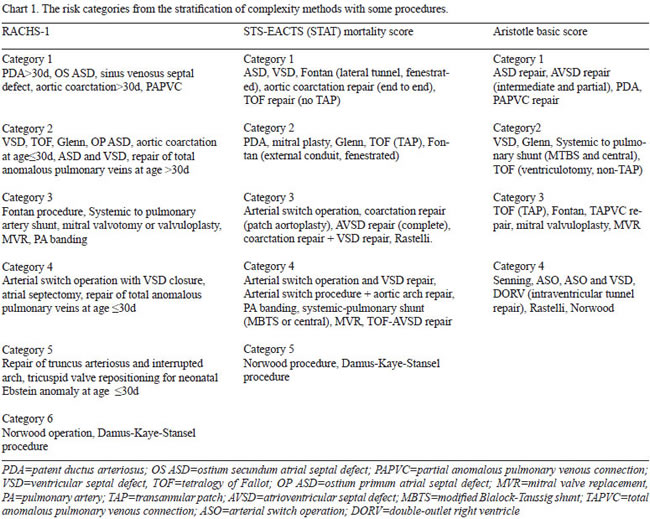
These scores risk stratify children based on the complexity of the cardiac surgical procedure rather than the underlying anatomy, pathophysiology, and child’s degree of clinical compensation.13-15 Watkins et al reviewed perioperative outcomes of all patients who underwent a cardiac procedure with a RACHS-1 score of 6, and included all who underwent non-cardiac procedures during the study interval interval. The authors identified independent risk factors for specific clinical outcomes and found that those patients before stage II single ventricle palliation, undergoing more invasive procedures, and receiving inotropes, angiotensin-converting enzyme inhibitors, or digoxin appear to be at increased risk for hemodynamic instability.
Furthermore, patients with preoperative length of stay greater than 14 days appear to be at greater risk for requiring postoperative mechanical ventilation. When LOS exceeding 14 days was accompanied by ventricular dysfunction, use of inotropes and not receiving digoxin these patients appear to be at increased risk of protracted hospitalization.16 Unfortunately, this score is a surgical risk stratification score used to compare inter-institutional perioperative morbidity and mortality following cardiac surgery rather than risk stratify children for non-cardiac procedures.
More recently, Faraoni et al reviewed children undergoing non-cardiac surgery through the National Surgical Quality Improvement Program (NSQIP). Children with major, minor, and severe CHD were matched with controls without CHD.17 Children with major and severe CHD had an increased risk of overall mortality compared with children without CHD (3.9% [moderate] and 8.2% [severe] versus 1.7% and 1.2%, respectively). This is an important multi-institutional analysis with established classifications of CHD from a large database.
Carmosino et al reported an increased risk of major complications, including cardiac arrest and pulmonary hypertension, in children with suprasystemic pulmonary hypertension.18 While Faraoni et al and Carmosino et al identify high-risk children for significant adverse events, these studies do not address common questions that often arise in the care of children with CHD undergoing non-cardiac surgery.
Is this child likely to have significant cardiopulmonary instability perioperatively requiring escalation in care? Can the procedure be performed safely in an outpatient surgery center rather than a tertiary center with cardiothoracic surgery and intensive care backup based on the child’s score? Does a poorly compensated child with a high-risk score need to see their cardiologist to optimize medical management prior to their elective procedure? Does that child need additional diagnostic tests or cardiac interventions prior to the procedure?
Preoperative risk assessment of adults with acquired heart disease has helped identify patients at risk for perioperative complications following non-cardiac surgery. Several risk scoring systems have been developed and validated to identify high-risk adult patients undergoing cardiac and non-cardiac surgery, including those by the American Heart Association (AHA) and the American College of Cardiology (ACC), the EUROSCORE, and the Cleveland Clinic score.19,20
The AHA/ACC system risk stratifies clinical predictors into major, intermediate, and minor predictors. These clinical predictors place adults undergoing non-cardiac surgery into high (>5%), intermediate (1-5%), or low (<1%) risk for perioperative complications. Risk adjustment for adult heart disease is potentially easier than pediatric heart disease since there is less variation in anatomy and pathophysiology. The development of a risk-stratification score for children with CHD undergoing non-cardiac procedures may not only help identify children at increased risk for perioperative complications but also aid in resource utilization. As score may help determine if it is appropriate for the anesthetic to be administered by an anesthesiologist who usually takes care of adults, a pediatric anesthesiologist, or a pediatric cardiac anesthesiologist. A score may provide crucial information to the child, the child’s family, and the entire perioperative team, including, the anesthesiologist, surgeon, cardiologist, and pediatrician.
Read an expert commentary on this article HERE.
References
- Tennstedt C, Chaoui R, Korner H, and Dietel M. Spectrum of congenital heart disease defects and extracardiac malformations associated with chromosomal abnormalities: results of as seven-year necroscopy study. Heart. 1999; 82:34-39.
- Gilboa S, Salemi J, Nembhard W, Fixler D, and Correa A. Mortality resulting from congenital heart disease among children and adults in the United States, 1999 to 2006. Circulation. 2012; 122: 2254-2263.
- Ramamoorthy C, Haberkern C, Bhananker S, Domino K, Posner K, Campos J, and Morray J. Anesthesia-related cardiac arrest in children with heart disease: data from the Pediatric Perioperative Cardiac Arrest (POCA) registry. Anesthes Analg. 2010; 110:1376-82.
- Baum V, Barton D, and Howard Gutgesell. Influence of congenital heart disease on mortality after non-cardiac surgery in hospitalized children. Pediatrics. 2000; 105:332-335.
- Flick R, Sprung J, Harrison T, Gleich S, Schroeder D, Hanson A, Buenvenida S, and Warner D. Perioperative cardiac arrests in children between 1988 and 2005 at tertiary referral center. Anesthesiology; 2007; 106:226-237.
- Warner M, Lunn R, O’Leary P, and Schroeder D. Outcomes of noncardiac surgical procedures in children and adults with congenital heart disease. Mayo Clinic Proceedings. 1998; 73:728-734.
- Hennein H, Mendeloff E, Ciley R, Bove E, and Coran A. Predictors of postoperative outcome after general surgical procedures in patients with congenital heart disease. Journal of Pediatric Surgery. 1994; 29: 866-870.
- Christensen R, Gholami A, Reynolds P, and Malviya S. Anaesthetic management and outcomes after non-cardiac surgery in patients with hypoplastic left heart syndrome: a retrospective review. European Journal of Anesthesiology. 2012; 29: 425-430.
- Kipps A, Ramamoorthy C, Rosenthal, and Williams G. Children with cardiomyopathy: complications after noncardiac procedures with general anesthesia. Pediatric Anesthesia. 2007; 17: 775-781.
- White M. Approach to managing children with heart disease for noncardiac surgery. Pediatric Anesthesia. 2011; 21: 522-529.
- Lake C. Anesthesia for noncardiac surgery in children with congenital heart disease. Recista Mexicana de Anestesiologia. 2004; 27: Suppl. 1, 63-66.
- Dorfman A, Odegard K, Powell A, Laussen P, and Geva T. Risk factors for adverse events during cardiovascular magnetic resonance in congenital heart disease. Journal of Cardiovascular Magnetic Resonance. 2007; 9: 793-798.
- Jenkins K, Gauvreau K, Newburger J, Spray T, Moller J, and Lezzoni J. Consensus-based method for risk adjustment for surgery for congenital heart disease. The Journal of Thoracic and Cardiovascular Surgery. 2002; 123: 110-118.
- Lacour-Gayet F, Clarke D, Jacobs J, Comas J, Daebritz S, Daenen W, Gaynor W, Hamilton L, Jacobs M, Maruszewski B, Pozzi M, Spray T, Stellin G, Tchervenkow C, and Mavroudis C. The Aristotle score: a complexity-adjusted method to evaluate surgical results. European Journal of Cardio-thoracic Surgery; 2004; 26: 911-924.
- O’ Brien S, Clarke D, Jacobs J , Jacobs M, Lacour-Gayet F, Pizarro C, Welke K, Maruszewski B, Tabota Z, Miller W, Hamilton L, Peterson E, Mavroudis C, and Edwards F. An empirically based tool for analyzing mortality associate with congenital heart surgery. The Journal of Thoracic and Cardiovascular Surgery. 2009; 138: 1139-1153.
- Watkins SC, McNew BS, and Donahue BS. Risks of noncardiac operations and other procedures in children with complex congenital heart disease. Ann Thorac Surg. 2013 Jan;95(1):204-11.
- Faraoni D, Zurakowski D, Vo D, Gooble SM, Yuki K, Brown ML, and DiNardo JA. Post-operative outcomes in children with and without congenital heart disease undergoing noncardiac surgery. J Am Coll Cardiol. 2016; 67(7): 793-801.
- Carmosino MJ, Friesen, Doran, and Ivy DD. Perioperative complications in children with pulmonary hypertension undergoing noncardiac surgery. Anesth Analg. 2007; 104(3): 521-7.
- American College of Cardiology, American Heart Association. Guidelines for perioperative cardiovascular evaluation and care for non-cardiac surgery. Circulation. 2007; 116: 418-500.
- Nashef SA, Roques F, Michel P, Gauducheau E, Lemeshow S, and Salamon R. European system for cardiac operative risk evaluation. European Journal of Cardiothoracic Surgery. 1999; 16(1): 9–13.


