


The Registry of the International Society for Heart and Lung Transplantation: Fifteenth Pediatric Heart Transplantation Report – 2012
Kirk R, Dipchand AI, et al. The Journal of Heart and Lung Transplantation 2012; 31(10): 1065-72
Reviewers: Peggy P. McNaull, MD and Jamie Wingate, MD
North Carolina Children’s Hospital
University of North Carolina
Department of Anesthesiology
Introduction
In 1980, the International Society for Heart and Lung Transplantation (ISHLT) was founded in an effort to promote scientific exchange amongst those physicians and scientists active in the field of cardiac transplantation as well as to serve as an interface between the cardiac transplantation community and health care financing agencies, other governmental and scientific interest groups, and the public.1 The society, in order to achieve their goals, developed a voluntary international registry. Since the registry’s inception, over 10,000 transplants in children have been reported. It is estimated that approximately two thirds of all thoracic transplants are registered in the ISHLT database.2
In 1997, the ISHLT began publishing an annual report in The Journal of Heart and Lung Transplantation describing the data collected by the registry for pediatric transplantation specifically. The Fifteenth Pediatric Heart Transplantation Report published in 2012 documents the evolving management of pediatric heart transplant recipients and their outcomes by describing the data collected in 2010 and comparing it to the data collected from 2000 onward.
Results
ISHLT registry data is collected from individual centers as well as national or regional organ procurement and organ exchange organizations. In 2010, 14% of all transplants reported to ISHLT were in patients under the age of 18. Throughout the year, 532 pediatric heart transplants were reported by 106 centers – 58 in North America, 40 in Europe, and eight in other parts of the world. From 2005 to 2010, 55% of the transplants described were undertaken in centers that do 10 or more pediatric transplants per year.
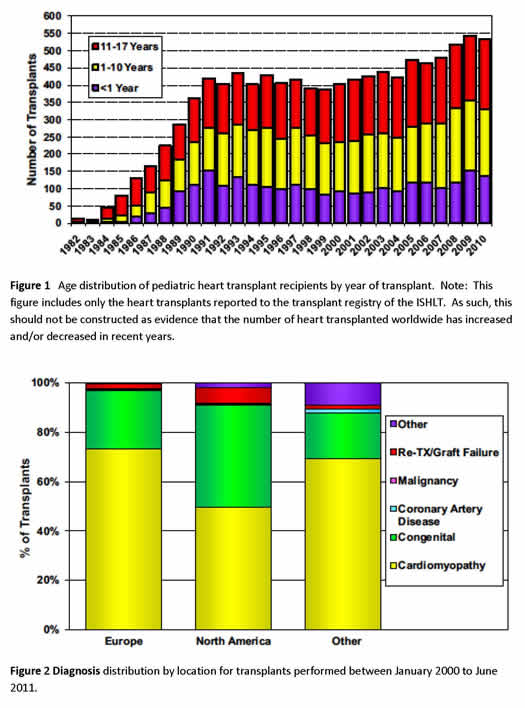
In 2010, 25% of pediatric transplant recipients were under 1 year, 37% were between 1 and 10 years, and 38% were between 11 and 17 years (Figure 1). Interestingly, North America performs significantly more transplants on children under the age of 1 than other parts of the world – 28% in North America, 12% in Europe, and 6% in the rest of the world. During infancy, congenital heart disease was the most common indication for transplantation (56%) followed by cardiomyopathy (40%). In children over 10, cardiomyopathy was the most common indication. However, geographic differences exist – congenital heart disease is a more common indication for transplantation in North America than other parts of the world (Figure 2).
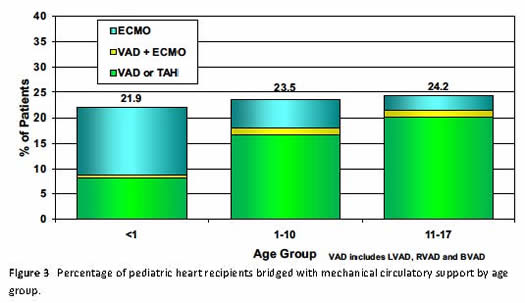
Between 2005 and 2010, there was a small increase in the number of pediatric transplant patients bridged to transport with mechanical support - 22% to 25%. However, there was a significant change in the type of mechanical support provided. In 2005, ECMO was utilized as a bridge to transplant in 9.4% of pediatric recipients. Most recently, in 2010, ECMO use has declined to 2.4% while the use of ventricular assist devices (VADs) increased from 12.1% to 20.4% during the 5-year period (Figure 3). ECMO, in 2010, was more commonly used in children under 1 one. With the recent North American approval of a ventricular assist device suited for infants and small children, it is expected that ECMO use as a bridge to transplant will continue to decline.
Allosensitization has great implications for both short term and long term survival in pediatric heart transplant candidates and recipients. Prior to transplant, sensitization is detected via testing that exposes HLA antigens from random individuals to the recipient's serum through a variety of different techniques, collectively referred to as a panel-reactive antibody (PRA) test. Sensitization in the pediatric population most often occurs following a blood transfusion and/or homograft placement during surgical repairs of congenital heart defects.
Allosensitization is also augmented following ventricular assist device implantation. A patient is considered sensitized when PRA measurements of greater than 10% for either class I or II HLA antigens are detected.3,4 ISHLT data demonstrated that the number of pediatric patients with PRA levels greater than 10% increased from 20% in 2005 to 29% in 2010.
Immunosuppressive agents decrease the likelihood of acute cellular rejection and increase post-transplant survival. Despite an increase in induction therapy with both anti-thymocyte globulin and interleukin-2R antagonists from 40% of patients in 2001 to 70% of patients in 2010, ISHLT data found no evidence of a decreased incidence of rejection between discharge and one year post-transplant. Investigators admit the database does not provide insight into the potential benefits induction therapy may have offered patients immediately post-transplant, prior to hospital discharge. Maintenance immunosuppressive regimens included a combination of a calcineurin inhibitor and a cell-cycle inhibitor, most commonly tacrolimus and mycophenolate mofetil. A significant number of patients were also maintained on corticosteroids. Survival was not influenced by induction or maintenance regimens. Those patients still on corticosteroids at 1 year, likely because of a history of rejection, had reduced survival.
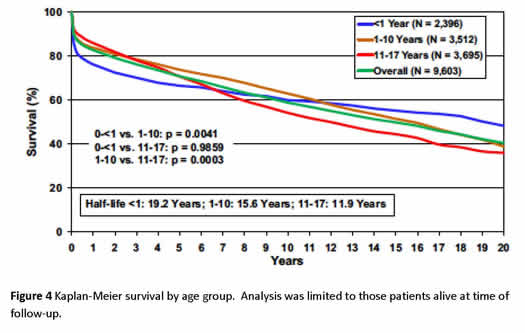
Data analysis revealed that patient survival was influenced by the patient’s age at transplant, era of transplant, diagnosis, and location. Despite higher early mortality (first few months post-transplant), younger transplant recipients survived longer than older ones. Median survival, defined as the time at which 50% of recipients remain alive, was 19.2 years for those transplanted during infancy, 15.6 years for children, and 11.9 years for adolescents (Figure 4). Median survival has improved with time. It was 9.2 years for patients transplanted between 1982 and 1989 and 13.9 years for those between 1990 and 1999. A diagnosis of infant cardiomyopathy was associated with improved survival at 10 years compared with congenital heart disease. Survival was also influenced by the geographic location where the transplant was performed. Survival rates for infants and children between one and 10 years were slightly lower in North America compared to Europe and the rest of the world. Authors advised caution when interpreting data related to geographic location. Multivariable analysis was not undertaken and outcomes may be related to different patient characteristics rather than transplant management.
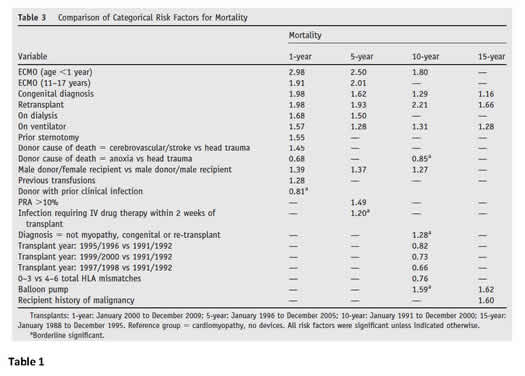
Mortality in recipients transplanted between 2000 and 2011 was highest during the first year post-transplant and was most commonly associated with graft failure including technical factors (28%). Multi-organ failure (16%), infection (14%), and rejection (14%) were also common causes. Three years post-transplant death from acute rejection and non-CMV infection declined, while cardiac allograft vasculopathy and graft failure together were responsible for greater than 50% of deaths. Multivariable analysis of risk factors for 1-, 5-, 10-, and 15-year mortality were reported as relative risk (RR) with either a corresponding p –value and/or 95% confidence limits (Table 1). ECMO at time of transplant, congenital diagnosis, retransplant, on dialysis, and on a ventilator were associated with a RR > 1 for 1-year and 5-year mortality. Factors specific to 1-year mortality included prior sternotomy, previous transfusion, donor cause of death - CVA vs. head trauma, and donor cause of death – anoxia vs. head trauma.
ISHLT data also revealed factors regarding post-transplant morbidity. Most of the data regarding functional status post-transplant originated from North American recipients transplanted between 2000 and 2011. At 1 year, 1.9% required total assistance and 1% at 5 years. Freedom from cardiac allograft vasculopathy (CAV) decreased in a linear fashion from time of transplant with 57% of recipients CAV-free at 12 years. Graft survival was only 60% at 2 years and 49% at 5 years after detection of CAV. At 15 years post-transplant, 10% of patients required renal replacement therapy or transplant. Sixteen percent of patients developed malignancy by 15 years post-transplant.
Conclusion
The Fifteenth Pediatric Heart Transplantation Report offers a wealth of information relevant to the practice of pediatric cardiac anesthesia. Although it cannot be assumed that the total volume of pediatric heart transplants performed worldwide is increasing from ISHLT data alone, an increased number of transplants are being reported each year to the registry. In North America alone, 58 centers reported to the registry in 2010. The data is encouraging in that survival statistics are improving. As databases like the ones maintained by International Society for Heart and Lung Transplantation and The Society of Thoracic Surgeons grow, it is inevitable that outcomes directly related to the anesthetic management of the pediatric patient presenting for cardiac surgery will be sought and further investigated. For the anesthesiologist, the data included in this most recent report highlights that there was, albeit small, an increasing number of children bridged to transplant with mechanical support. It also revealed that more VADs were being utilized as compared to ECMO in previous reports. Considering this new trend, it is paramount that the pediatric cardiac anesthesiologist be familiar with the various pediatric VADs available, how they function, and the anesthetic implications surrounding implantation.
References:
- Ventura HO, Mandeep RM, Rowe A. (2005). A Quarter Century of Achievements in Heart and Lung Transplantation [Power Point Slides]. Retrieved from the International Society for Heart and Lung Transplantation website: https://www.ishlt.org/ContentDocuments/25thAnniversaryFinal.ppt
- Stehlik J, Edwards LB, Rowe A et al. ISHLT International Registry for Heart and Lung Transplantation – three decades of scientific contribution. Transplantation Reviews 2013; 27(2): 38-42.
- Velez M, Johnson. Management of allosensitized cardiac transplant candidates. Transplant Reviews 2009; 23(4):235-47.
- Scott V, Williams RJ, Levi DS. Outcomes of cardiac transplantation in highly sensitized pediatric patients 2011; 32(5): 615-20.
